

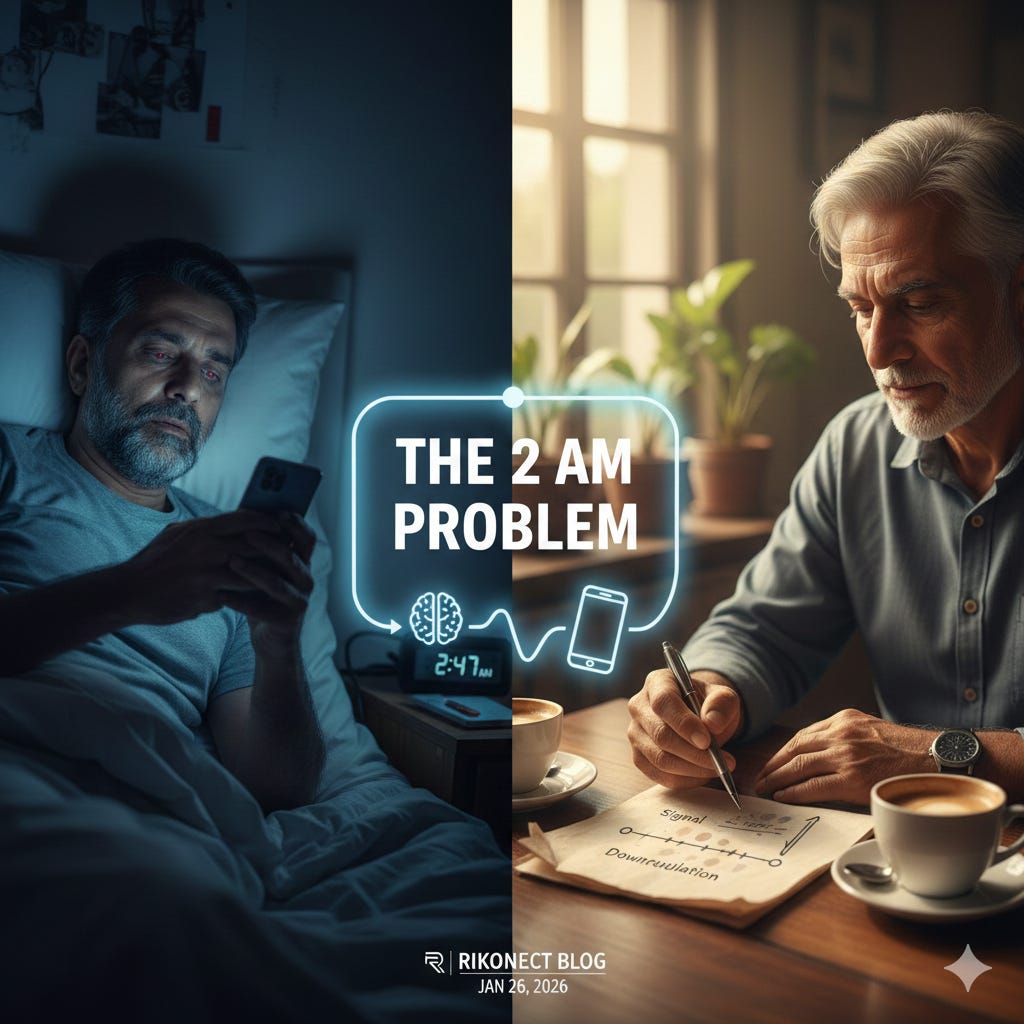
Arjun stared at the ceiling. 2:47 AM.
He had a presentation to the leadership team in six hours. The most important presentation of his quarter. He knew he needed sleep.
And yet, twenty minutes ago, he had picked up his phone “just to check one thing.”
Now here he was. Eyes burning. Thumb still scrolling. Mind completely empty.
He wasn’t even looking at the content anymore. Just moving. Swiping. Waiting for something. He didn’t know what.
He put the phone down. Picked it up again. Put it down.
Finally, he shoved it under his pillow and turned over.
But sleep didn’t come. His mind was buzzing with a strange, restless energy. Not anxious thoughts about the presentation. Just... noise. Like a television playing static in another room.
This had been happening more and more lately.
The presentation went fine. Not great. Fine.
Arjun sat in his office afterward, coffee in hand, trying to focus on emails. But his mind kept drifting. He checked his phone. Nothing new. Checked it again. Still nothing.
He thought about the night before.
If I wasn’t enjoying the scrolling, why couldn’t I stop?
It bothered him. He was a rational person. He ran a team of forty. He made decisions that affected millions in revenue. He could delay gratification when it mattered.
So why did a stupid app have more control over him than he had over himself?
That weekend, Arjun met his uncle Venkat for their monthly coffee.
Venkat had been a neuroscientist before retiring. Now he spent his time reading, walking, and asking questions that made Arjun uncomfortable.
“You look tired,” Venkat said.
“I am tired.”
“Sleeping poorly?”
Arjun hesitated. Then told him about the 2 AM scroll. The restlessness. The strange inability to stop doing something he wasn’t enjoying.
Venkat listened without interrupting. When Arjun finished, his uncle smiled.
“Let me ask you something. Why do you think you kept scrolling?”
“I don’t know. Habit? Addiction?”
“Those are labels. Not explanations.” Venkat took a sip of his coffee. “What if I told you your brain was doing exactly what it’s designed to do?”
“Then I’d say the design is flawed.”
Venkat laughed. “The design is perfect. For a different environment.”
“Have you heard of dopamine?” Venkat asked.
“Sure. The pleasure chemical.”
“That’s what everyone says. And everyone is wrong.”
Arjun frowned. “What do you mean?”
“Dopamine isn’t about pleasure. It’s about anticipation. It spikes before you get a reward, not during.”
Venkat pulled out a pen and drew on a napkin. A simple timeline. A dot marked “Signal.” Another dot marked “Reward.”
“In the 1990s, a researcher named Schultz did an experiment with monkeys. He gave them juice and measured dopamine. When do you think the dopamine spiked?”
“When they got the juice?”
“That’s what everyone assumed. But no. It spiked here.” Venkat pointed to the first dot. “When they saw the signal that juice was coming. The anticipation. By the time the juice arrived, dopamine had already dropped.”
Arjun stared at the napkin.
“So the wanting is separate from the liking?”
“Exactly.” Venkat tapped the pen on the table. “Dopamine drives seeking. It makes you chase. It doesn’t deliver satisfaction. That’s a different system entirely.”
Arjun thought about this for a moment.
“Okay. But what does that have to do with my phone?”
Venkat smiled. “Everything. Tell me, when you were scrolling at 2 AM, were you enjoying it?”
“No.”
“But you kept going.”
“Yes.”
“Why?”
Arjun opened his mouth. Closed it. Then: “Because... something interesting might be next?”
Venkat nodded slowly. “And was it?”
“Sometimes. Mostly not.”
“But you didn’t know which scroll would deliver. So you kept going.”
Arjun felt something click.
“It’s like a slot machine.”
“It’s exactly like a slot machine.” Venkat leaned back. “Variable rewards. Sometimes you win, mostly you don’t, and you never know which pull will pay off. This is the most powerful dopamine trigger known to behavioral science. And your phone is full of slot machines.”
They sat in silence for a moment.
“So I’m not weak,” Arjun said. “I’m just... hacked?”
“You’re human. Operating in an environment your brain didn’t evolve for.” Venkat finished his coffee. “But there’s something else you need to understand.”
“What?”
“What happens when you pull the lever too many times.”
Venkat drew another diagram. A simple line with receptors.
“When any system is overstimulated, it protects itself. It becomes less sensitive.”
“Like caffeine tolerance.”
“Exactly like caffeine tolerance. Drink coffee every day, you need more coffee to feel awake. Your adenosine receptors downregulate.”
Arjun nodded.
“Dopamine receptors do the same thing. When you bombard them with high-stimulation input, notifications, feeds, instant everything, they downregulate. They become less responsive.”
“What does that feel like?”
Venkat looked at him. “You tell me. What does it feel like when things that used to be enjoyable feel flat? When tasks that require effort feel unbearable? When you need more stimulation just to feel normal?”
Arjun didn’t answer. He didn’t need to.
“And boredom,” Venkat continued. “What does boredom feel like now?”
“Unbearable,” Arjun admitted. “I can’t even wait in line without reaching for my phone.”
“That’s the downregulation talking. Your baseline has shifted. What used to be enough isn’t enough anymore.”
Arjun stared at his coffee. It had gone cold.
“So what do I do? Throw away my phone?”
Venkat shook his head. “That’s what everyone tries. Willpower. Discipline. Delete the apps, white-knuckle through the cravings.”
“It doesn’t work.”
“It doesn’t work because you’re fighting biology with intention. Biology usually wins.”
“Then what?”
Venkat smiled. “You don’t fight the system. You understand it. And then you work with it.”
“There’s good news,” Venkat said. “Receptors can upregulate. Baseline can restore. The brain adapts in both directions.”
“How long does that take?”
“Depends. But most people feel a shift within a few weeks. The key is strategic reduction. Not elimination. Not punishment. Just... creating space.”
“Space for what?”
“For your brain to recalibrate. For the noise to quiet down. For simple things to start feeling like enough again.”
Arjun thought about this.
“What would that look like? Practically?”
Venkat leaned forward. “Start small. What’s the first thing you do when you wake up?”
“Check my phone.”
“What if you didn’t? For the first hour.”
Arjun laughed. “That sounds impossible.”
“It sounds impossible because your dopamine system has been trained to expect it. The first few days will be uncomfortable. You’ll feel restless. Your hand will reach for something that isn’t there.”
“And then?”
“And then it gets quieter. The craving softens. You start noticing things you missed. The morning starts to feel different.”
Arjun tried it.
The first three days were brutal. He described it later as an itch he couldn’t scratch. His hand kept reaching for the nightstand. His mind kept inventing reasons why he needed to check.
But he held the line.
By day five, something shifted. The itch was still there, but quieter. He noticed the light coming through his window. He heard birds he’d never registered before.
By day fourteen, he didn’t want to go back.
“It’s not that I have more willpower,” he told Venkat at their next coffee. “It’s that I want it less. The craving got quieter.”
Venkat nodded. “That’s what happens when the receptors start to normalize. You’re not fighting anymore. You’re just... choosing.”
Arjun still has his phone. He still uses social media.
But something is different now.
He doesn’t scroll at 2 AM anymore. Not because he’s more disciplined. But because he understands what’s happening. And understanding changed what he wants.
The restlessness still visits sometimes. But now he recognizes it.
That’s just dopamine looking for a hit.
And he can let it pass.
What Arjun Learned
The phone isn’t the problem. The design is the problem.
Dopamine isn’t about pleasure. It’s about anticipation. And every app on your phone is engineered to keep you anticipating.
When you understand this, you stop blaming yourself. You start seeing the game clearly.
And you can start making different choices. Not through willpower. Through design. Through environment. Through small, strategic reductions that let your brain recalibrate.
It doesn’t require perfection. It requires patience.
And it starts with understanding.
Where We Come In
Arjun’s story isn’t unique. We hear versions of it every week.
At Rikonect, we’ve built a 30-day program around this science. Each day, you learn something about how your brain works. And you take one small action that helps it recalibrate.
Not willpower-based. Not shame-based. Education-based.
Because once you see the game clearly, you can choose how you want to play.
Launching soon. Stay tuned.
Have your own 2 AM story? We’d love to hear it.