

Meera couldn’t stop thinking about the conversation with her mother.
“How many of your 843 friends would visit you in the hospital?”
The question haunted her. She started mentally sorting. Close friends. Good friends. People she actually talked to. People who knew what was happening in her life.
The numbers got small fast.
That weekend, she went back to her mother’s house.
“I’ve been thinking about what you said. About friends.”
Her mother looked up from her tea. “And?”
“How do you know? How do you know who’s really a friend and who’s just... a connection?”
Her mother smiled. “There’s some science on this, actually. Would you like to hear it?”
“You have science?”
“I read. I’m old, not dead.”
“There was a British anthropologist named Robin Dunbar,” her mother began. “He studied primates. Monkeys and apes. He noticed something interesting: the size of a primate’s social group was correlated with the size of their neocortex.”
“The brain predicts the group size?”
“The brain limits the group size. There’s only so much social information we can track. Who’s allied with whom. Who owes what to whom. Who can be trusted. The bigger the brain, the more relationships you can manage. But there’s always a ceiling.”
“And for humans?”
“For humans, the number is about 150. That’s the maximum number of stable social relationships a person can maintain. Beyond that, you can’t keep track. People become strangers with familiar faces.”
“But 150 still seems like a lot,” Meera said.
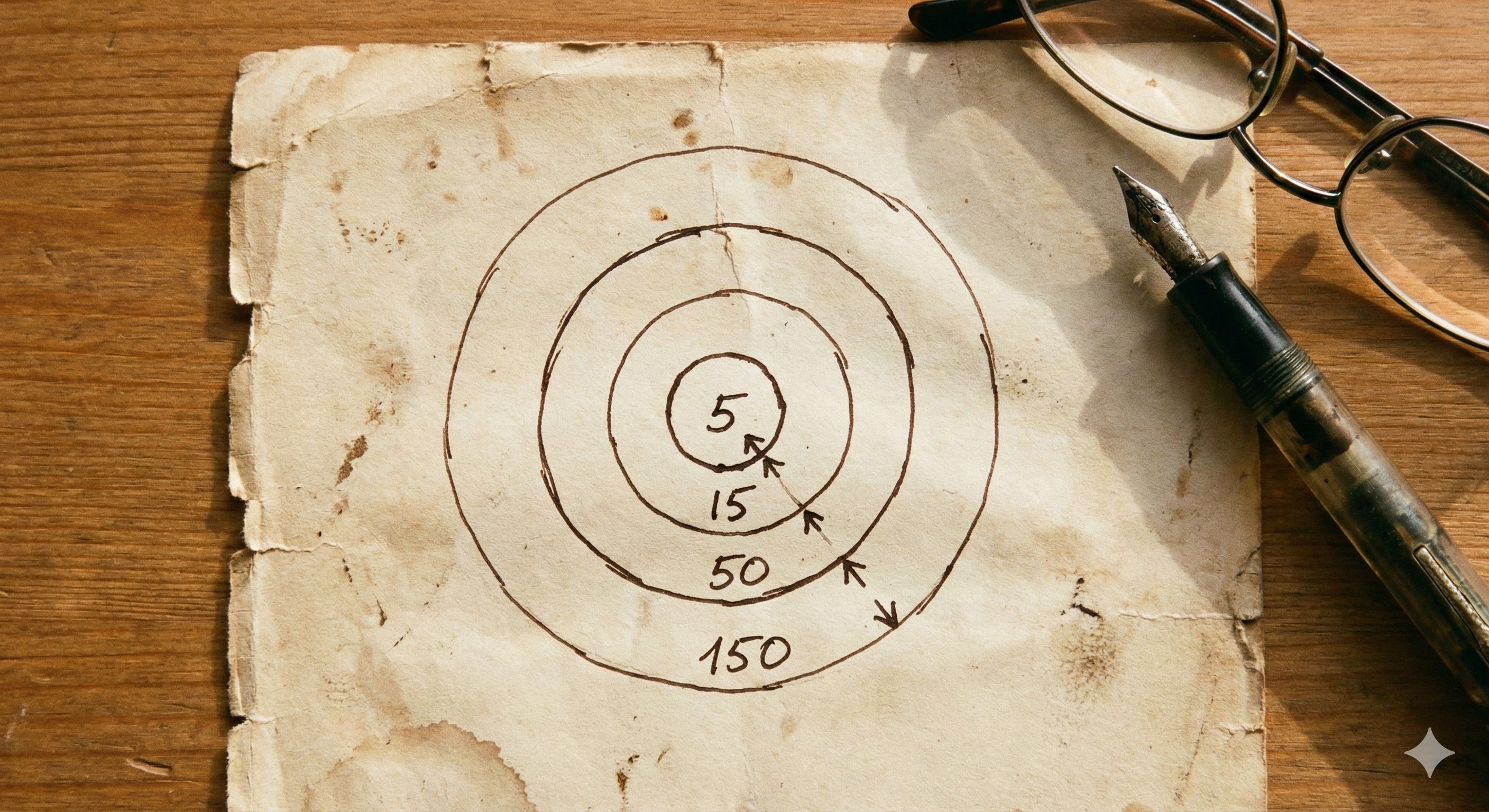
“It’s the outer layer. Dunbar found that relationships exist in layers. Like circles within circles.”
Her mother picked up a pen and drew on a napkin. Concentric circles, getting smaller toward the center.
“The outermost circle: about 150 people. These are meaningful contacts. You know them. You’d recognize them. You could have a conversation. But you don’t share deep intimacy.”
“Like colleagues. Extended family.”
“Exactly. One layer in: about 50 people. These are friends. You’d invite them to a party. You enjoy their company. You know something about their lives.”
“Okay.”
“One layer further: about 15 people. Good friends. You’d seek them out. You’d share personal things. You’d notice if you hadn’t talked in a while.”
“And the innermost?”
Her mother tapped the smallest circle. “About 5 people. Your core. Your closest confidants. The people who would visit you in the hospital. The people you’d call at 3 AM.”
“Five people,” Meera said quietly. “That’s it?”
“That’s the biological limit for deep intimacy. Your brain can only maintain about five relationships at that level of closeness. Not because you don’t care about more people. Because there isn’t enough cognitive and emotional bandwidth.”
Meera thought about her 843 Facebook friends. Her 1,200 LinkedIn connections. The thousands of faces that scrolled past her every week.
“We’re wired for villages. And we live in cities of millions.”
“We’re wired for villages. And we carry the entire world in our pockets. Every notification, every update, every piece of news about someone we barely know, it all competes for the same limited bandwidth.”
“So what happens?” Meera asked. “When we try to maintain more than we’re built for?”
“Something has to give. Usually it’s depth. You spread your attention across hundreds of shallow connections, and the deep ones starve. You know what an acquaintance ate for breakfast. You don’t know your best friend is sick.”
Meera winced. “That’s exactly what happened with Priya.”
“It’s what happens to all of us. The shallow is endless and easy. The deep requires effort and intention. And we’re drawn to easy.”
“The cruel irony,” her mother continued, “is that the shallow connections don’t satisfy. They give the illusion of being connected without any of the benefits.”
“What do you mean?”
“The research on wellbeing is very clear. The quality of your close relationships is the single strongest predictor of happiness and health. Not the quantity. The quality. Five deep relationships matter more than five hundred shallow ones.”
“So more connections can actually make us lonelier?”
“If they substitute for depth rather than supplement it, yes. You can be surrounded by a crowd and starving for intimacy. That’s modern loneliness. Not the absence of people. The absence of presence.”
Meera looked at the concentric circles on the napkin.
“So who’s in my five?”
“Only you can answer that.”
“How do I know?”
Her mother thought for a moment. “Ask yourself: who would I call at 3 AM? Who would drop everything if I needed them? Who knows what I’m actually going through, not what I post, but what I feel?”
Meera closed her eyes. Faces came to mind. Her mother. Her sister. Her husband. One friend from college.
“Four. I can think of four.”
“That’s not bad. Most people overestimate this number. They think they have more than they do. Then something happens, and they discover the truth.”
“What about the fifth?”
Her mother smiled. “Maybe Priya. Maybe that relationship isn’t lost. Maybe it’s just been neglected.”
Meera drove home thinking about layers.
She had been investing in the wrong circles. Spending hours on the outer edges. Scrolling through the lives of people she barely knew. Liking posts from acquaintances. Consuming updates from strangers.
Meanwhile, the inner circles had been starving.
She hadn’t called her sister in weeks. She and her husband had been eating dinner in front of screens. Priya had drifted so far that she had missed months of illness.
The bandwidth was finite. And she had been spending it on the wrong things.
That night, she made a list.
My 5:
Mom
Anita (sister)
Rahul (husband)
Priya
(open)
My 15: (She had to think hard here. It took twenty minutes to write fifteen names. Some surprised her. Some were people she hadn’t talked to in months.)
She looked at the list for a long time.
Then she started with the inner circle. One call at a time.
What Meera Learned
Relationships exist in layers. Five closest. Fifteen good friends. Fifty friends. One hundred fifty meaningful contacts. That’s the biological limit.
The outer layers are easy and infinite. The inner layers require effort and intention. Modern life makes it easy to spread thin and starve deep.
Quality predicts wellbeing. Not quantity. Five deep relationships matter more than five hundred shallow ones.
The first step is knowing who’s in each circle. The second step is investing accordingly.
Where We Come In
At Rikonect, we help you focus on the relationships that matter.
Not more connections. Deeper ones. Tools to remember, to invest, to show up for the people in your inner circles.
Because your bandwidth is finite. Where you spend it is your choice.